Simple Water Rockets

 - by KitchenPantryScientist

You’ll have a blast learning physics by making water rockets!

While NASA’s rockets use rocket fuel as their working  mass, these rockets use water.  As pressurized air forces the water out of your rocket, the rocket moves in the opposite direction, just like Newton’s Third Law says it will. “For every action, there is an equal and opposite reaction.”

Although these rockets lack fins, a payload and a nose cone, you can see from this NASA illustration that they’re very similar to real rockets.  You can make a complicated launch pad like this, but we decided to make things easy.

For this experiment, you’ll need:

-an empty one or two liter bottle from a carbonated beverage

-a cork that has been cut in half and will fit in the mouth of your bottle  (An adult should do this. I used a serrated knife.)

-a needle for inflating balls

-a bike or ball pump

-a cardboard box cut to hold the bottle at an angle pointing away from you. This is your launch pad.

Push the needle through the cork so that it pokes out of the other side. Use the hole from the corkscrew to make it easier.
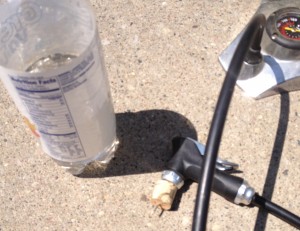
Needle should poke all the way through the cork.

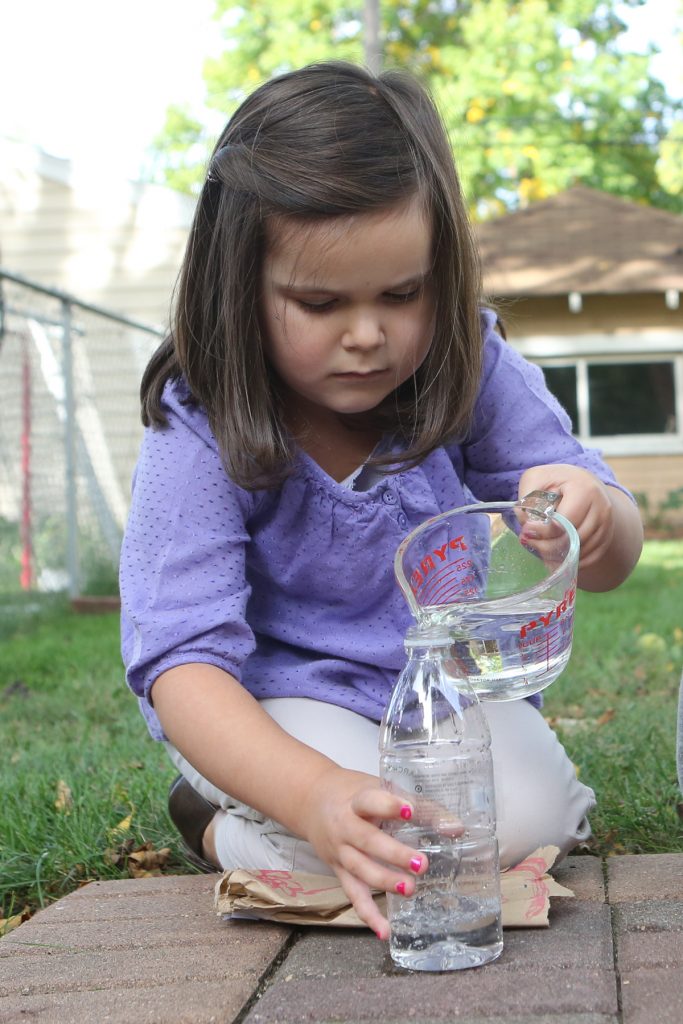
Fill the bottle about 1/3 of the way full of water and insert the cork in the bottle.

Set the bottle in the cardboard box so that it’s pointing up, but away from you. See the photograph.
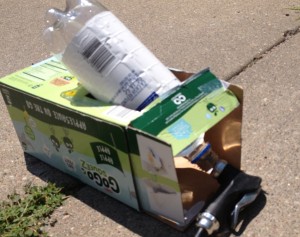
water rocket in launch pad

Attach the needle to the bike pump, stand behind the launch pad and start pumping air into the bottle.  The air pressure will build in the bubble at the top of the rocket. When the pressure gets high enough, it will force the cork and water out of the bottle with lots of force, and as the water shoots down, the rocket will shoot up!

What happens if you add more water, or less water to your rocket?

Can you imagine riding a real rocket? Check out Astronaut Abby’s website to meet a girl who wants to ride a rocket some day and ask an astronaut on the International Space Station questions!
 

Paper Bag Volcano

 - by KitchenPantryScientist

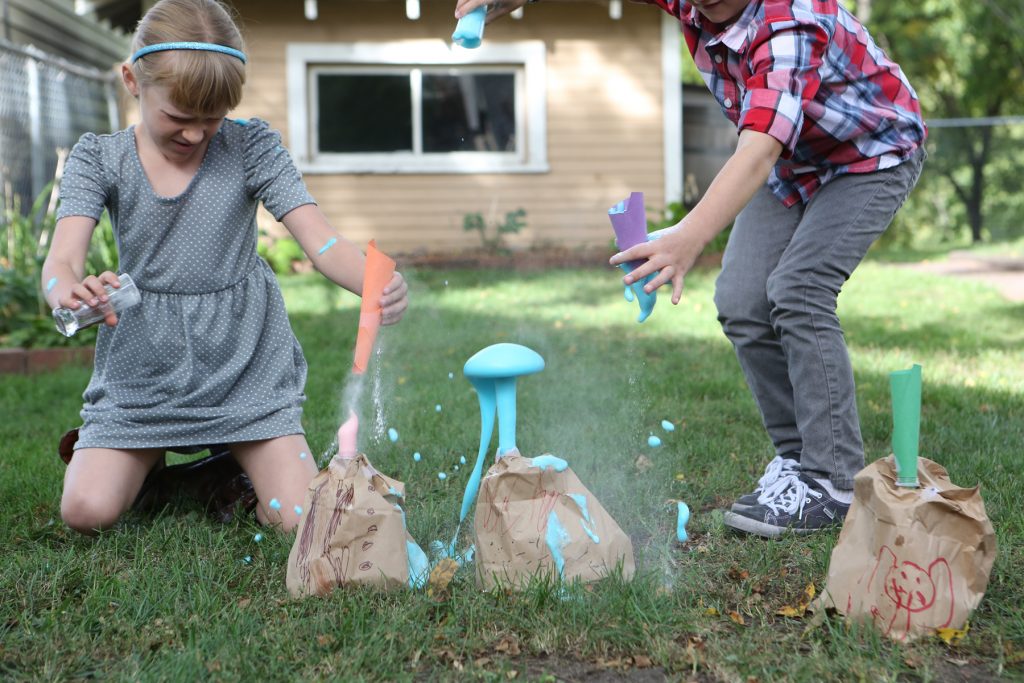
Last spring, I went into my daughter’s first grade classroom to do the famous volcano experiment that involves mixing baking soda (sodium bicarbonate) and vinegar (acetic acid). Unfortunately, with our hectic schedule there was no time to create a “work of art” volcano from paper mache or clay. So, we made one out of a paper bag. It was a smashing success.

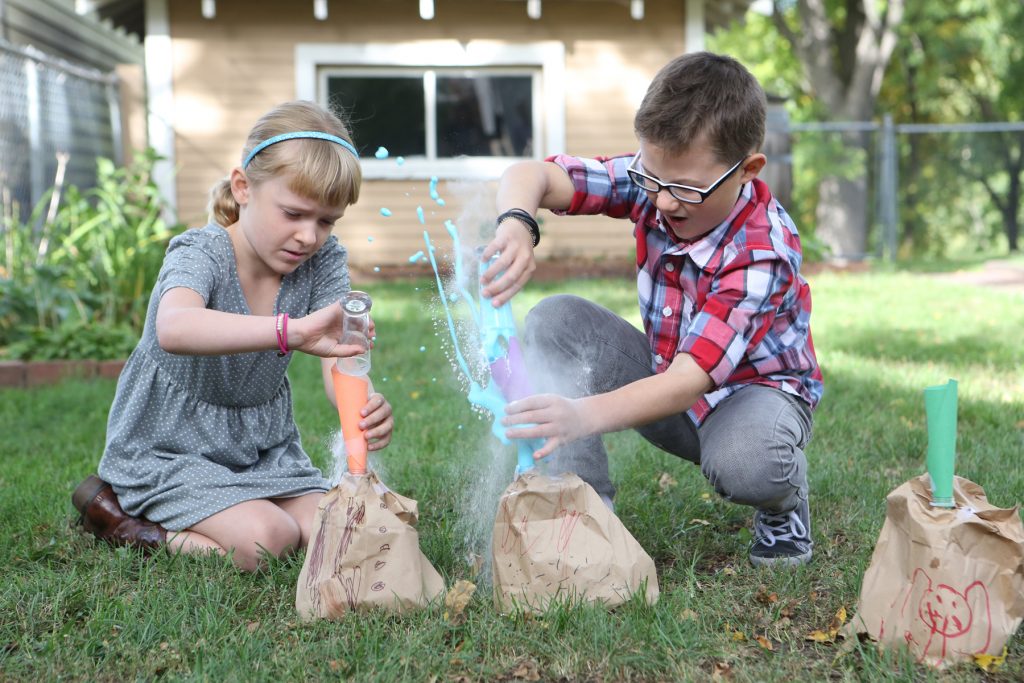
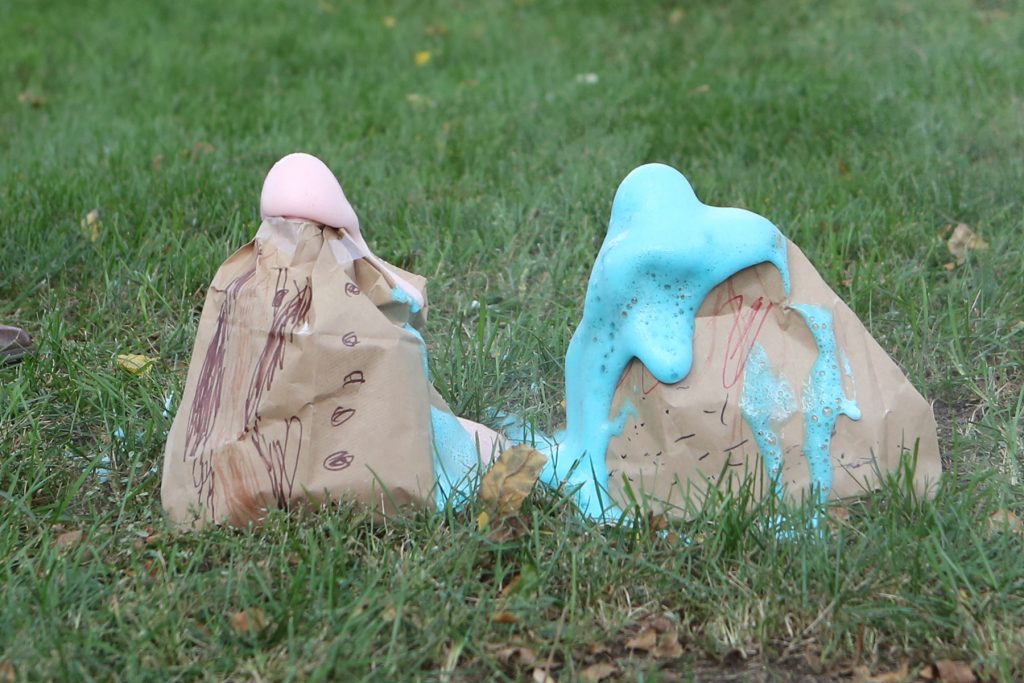
Paper bag volcanoes (image from Kitchen Science Lab for Kids- Quarry Books 2014

Paper bag volcanoes (image from Kitchen Science Lab for Kids- Quarry Books 2014

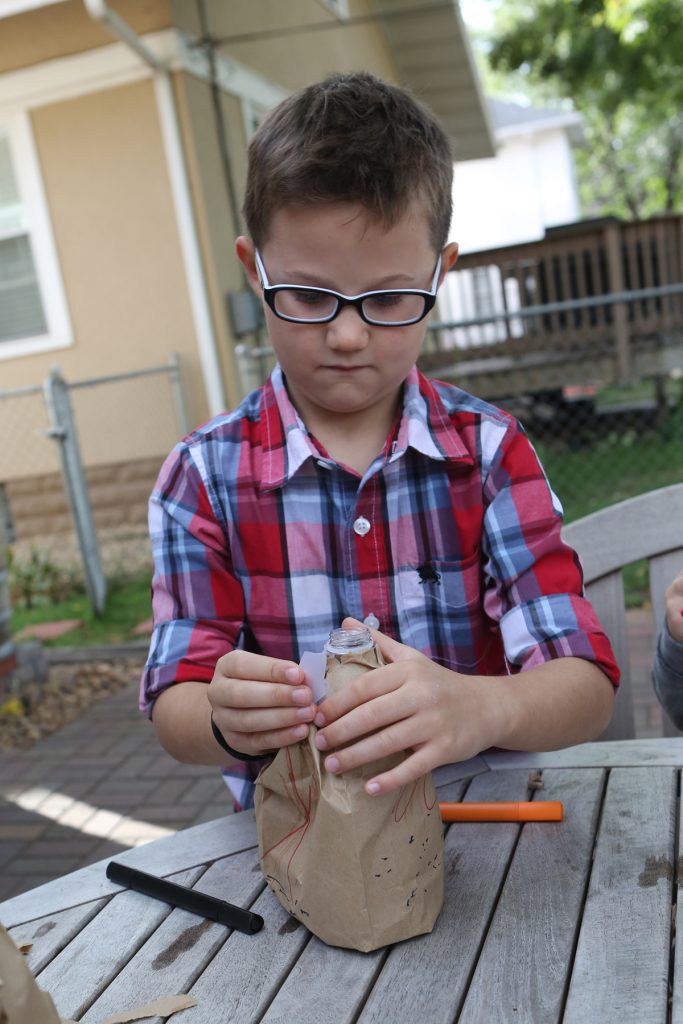
To make your own paper bag volcano, you’ll need a brown paper lunch sack (or a slightly bigger one like we used), an empty plastic water or soda bottle, a cup of vinegar, red food coloring and about a fourth of a cup of baking soda. *Cone coffee filters make great volcano cones too and work well on small plastic bottles! 

CZ1A6754p

Remove the lid from the bottle, invert the brown bag over it, and tear open the bottom of the bag, along the flaps. Then, loosely tape the paper sack so that it fits around the mouth of the bottle. Don’t tape it to the bottle. If you like to draw, you can decorate the bag with markers.. We squashed and tore the bottom of the bag a little, to make it look more mountain-like.

Now, remove the bottle, fill it with the vinegar and add several drops of red food coloring for your “lava.” Place the bag bag over the bottle to hide the lava container.

CZ1A6762p


Place the volcano on a tray or something that will contain overflow and you’re ready for eruption!

Using a folded piece of paper, quickly dump all of the baking soda into your bottle to start the chemical reaction. You’ll see the volcano erupt as the baking soda combines with the vinegar to produce carbon dioxide gas, which is one of the gases spewed by real volcanoes.

From Kitchen Science Lab for Kids (Quarry Books 2014)

From Kitchen Science Lab for Kids (Quarry Books 2014)

From Kitchen Science Lab for Kids (Quarry Books 2014)

From Kitchen Science Lab for Kids (Quarry Books 2014)

If you liked this experiment, try making fizzy balloons with the same ingredients (plus a balloon, of course!) If you want to learn more about carbon dioxide gas and the carbon cycle, here’s a link to a cool video from NASA that explains it using a banana and a chunk of coal.

Red Sunset Science Experiment

 - by KitchenPantryScientist


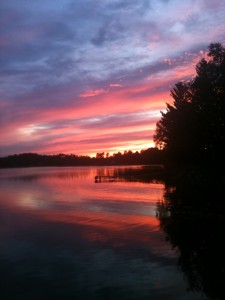
When Krakatoa erupted in 1883, the explosion and resulting tsunamis killed around 40,000 people, forever changed the geography of the East Indies, spewed tons of sulfur dioxide and ash into the atmosphere, and resulted in some of the most spectacular sunsets in recorded history. Artists and writers around the world tried to capture the blazing sky on paper, and some speculate that the psychedelic sky in Edvard Munch’s “The Scream” was inspired by a Krakatoa sunset.

Why are sunsets red? And how would volcanic ash make them even redder?

The colors we see depend on the light waves that are reflected and absorbed by the things around us. For example, grass looks green since it absorbs most of the visible light waves except green, reflecting that color back at our eyes.  Things that look black absorb all the colored light waves. Blue light has a short wavelength, and easily bounces off surrounding particles (called scattering), while red light has a longer wavelength and is more difficult to scatter.

The oxygen and nitrogen that make up most of our atmosphere are good at filtering out blue and violet light, but your eyes are good at seeing blue light and sunlight doesn’t have to travel though much atmosphere when it’s directly overhead, so the sky looks blue on a sunny day.

As the sun sets, its light has to travel a longer distance across the atmosphere to reach your eyes. By the time we see it, many of the blue light particles have been filtered out, allowing you to see the red, yellow and orange light waves that remain. In addition, the lower atmosphere contains more large particles like dust and pollen, which scientists call aerosols. These particles scatter the blue light even more, allowing you to enjoy the red, yellow and orange light waves that remain to create a beautiful sunset.

The ash from Krakatoa was a very effective blue light filter, making the skies so red that fire engines were called out in New York.

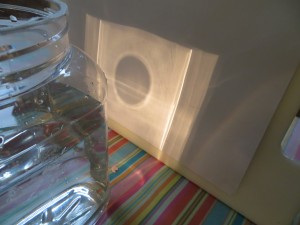
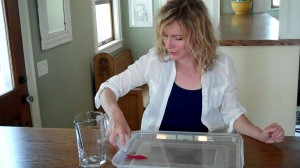
To see how particles scatter light, fill a plastic container with water and shine a flashlight through it on to a white piece of paper. The light should look white.

flashlight beam through water

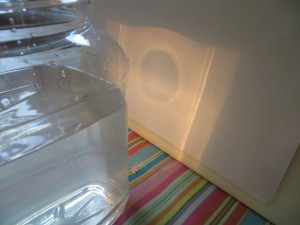
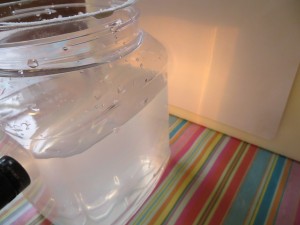
Now add a few drops of milk to the water and shine your light through again. Does the color change? What if you add more milk or use a longer container, so the light has to travel farther?

flashlight beam through water with milk added

flashlight beam through water with more milk added

What happened? Imagine that your flashlight is the sun and the milky water is the lower atmosphere.  The molecules in milk are filtering out the blue light in your flashlight beam, allowing you to create your own red “sunset.”

The Kaye Effect

 - by KitchenPantryScientist

Have you ever wondered why it’s so hard to get ketchup flowing out of a bottle, or why no-drip paint doesn’t drip?

Ketchup, no drip paint, liquid soaps and shampoos are all part of a really amazing category of fluids known as “shearing liquids.” These fluids are pretty thick when they’re sitting still, but they get thinner or more “liquidy” as they flow, because movement decreases their viscosity, or thickness, making them more slippery.

Back in 1963, an engineer named Arthur Kaye noticed streams of liquid shooting from the surface below a stream of shearing liquid he was working with. This strange, short-lived phenomena became known as the Kaye effect.

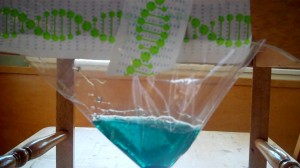
With a chair, tape, some dish soap and a plastic ziplock bag, you can do your own Kaye effect experiment at home and watch soap jets shoot like ski jumpers from the very slippery shearing liquid soap pile below

-Tape a plastic ziplock bag to a chair with one corner or the bag pointed toward a plate underneath. The bag corner nearest the floor should be around 20 cm (about a foot) from the floor.
-Fill the bag with liquid soap or dish detergent. We added a few drops of food coloring to ours.
-Cut off the corner of the bag closest to the floor with scissors to make a tiny hole for the soap to flow through (1mm.) You may have to make it a little bigger, but you want a very thin, steady stream of soap flowing to the plate.
-Watch for jumping streams of soap. If it’s not working, try changing soap and adjusting bag hole size and bag height! What happens if you put the plate below at an angle?

To learn more about the Kaye effect and other cool physics stuff, visit Dr. Skyskulls’ website. He’s the physicist who told me about this experiment and helped me work out the protocol.

Physics Fountain

 - by KitchenPantryScientist

We played around with dish soap this weekend to watch the Kaye effect, which I learned about from my physicist friend Dr. SkySkull.

It’s an experiment in liquid dynamics, and I’ll post a protocol (recipe) for how to do it in the next day or two.


Surface Tension in Space

 - by KitchenPantryScientist

If you’ve done an experiment where you drip water onto a penny, or made Tie Dye Milk, you know what surface tension looks like here on Earth. How does it look in space?

Here’s an amazing video demonstrating how the surface tension of water looks in zero gravity on the international space station. Fascinating!

Photosynthesis Experiment

 - by KitchenPantryScientist

Plants are wonderful chemical reorganizers.  Using the sun’s energy and a process called photosynthesis, they can turn water and carbon dioxide into sugar (glucose) and oxygen.

Thanks to plants and other autotrophs like algae, Earth has an oxygen-containing atmosphere that can sustain animal and human life.

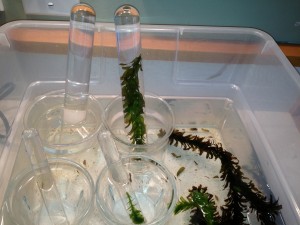
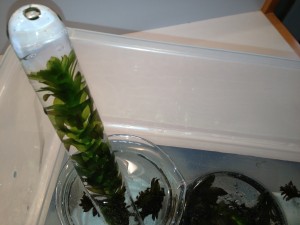
To watch plants make oxygen, all you need is a water plant like Elodea (available at pet stores), a large container, water and a few small clear glasses or test tubes.

Fill the large container with water and turn your small, clear containers on their sides underwater to remove all the air bubbles.

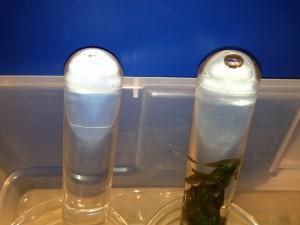
Cut a branch off of your plant, place it under water in the large container, shake off any air and put it under your small, clear container- stem side up. Invert the small container, allowing no air to enter it. Repeat the experiment with your other small clear container, but don’t add a plant. This is your control. If you’re using test tubes, you can put them in small cups or beakers so they don’t tip over. (See photo above.)


Place your experiment in bright sunlight or near a strong lamp and observe what happens. You should see oxygen bubbles form on the plant as it performs photosynthesis.  In a test tube, you will eventually see some water displaced by oxygen.

What happens if you duplicate the experiment in a room with no light?

Tap water contains some carbon dioxide. How do you think the experiment would work with lake or pond water?


Earth Day Science Experiments

 - by KitchenPantryScientist

Here are some of our favorite environmental science experiments. Click on the experiment name for directions and photos. I’ll post a new photosynthesis experiment on Monday!

Window Sprouts: Plant a bean in a plastic baggie with a damp paper towel to see how plants need only water and air to sprout roots and leaves.  Here’s a short video demonstrating how to make a window garden.

Homemade Solar Oven: Using a pizza box, aluminum foil, plastic wrap, and newspaper, you can harness the sun’s energy to cook your own S’mores!

Nature Walk Bracelets: Wrap some duct tape around your wrist (inside out) and take a walk, sticking interesting natural objects like leaves and flowers to your bracelet. It’s a great way to get outdoors and engage with nature!

Carbon Dioxide and Ocean Acidity: See for yourself how the carbon dioxide in your own breath can make a water-based solution more acidic. It’s the same reason too much carbon dioxide in Earth’s atmosphere can be bad for our oceans.

Plant Transpiration:  See how trees “sweat” in this survival science experiment.

Earthworm Experiment:  Do you know what kind of earthworms are living in your back yard?

Composting: Be a composting detective. Bury some things in your back yard (away from power cables) and dig them up in a few months to see how they look. Composting reduces methane gas emissions (a greenhouse gas) from dumps.

Diffusion and Osmosis: See for yourself how the chemicals we add to water, put on our streets to melt ice, and spray on our lawns and crops can move into our soil, ground water, rivers, lakes and oceans.

Solar Water Purification: This project illustrates the greenhouse effect and is a fun “survival science” experiment. Requires hot sun and some patience!

Citizen Science: Don’t forget about all the real environmental research projects you can participate in through Citizen Science programs all around the world!

For mores activities and games, check out NASA’s Climate Kids website, to see a kid-friendly diagram of the water cycle, click here or just get outside and enjoy the beautiful planet that sustains and nurtures us.

Joseph Priestly: Kitchen Sink Scientist

 - by KitchenPantryScientist

We kicked off a new experiment today in honor of upcoming Earth Day. Details and an Earth Day experiment “round-up” coming soon!

Joseph Priestly was an amateur scientist who started out doing experiments in his kitchen sink. Eventually, he was credited with being among the first scientists to isolate oxygen. He noticed that in a sealed container, fire burned something away that animals needed to survive (oxygen) and that plants could replace this mysterious element. This research inspired him to become one of the earliest natural philosophers to hypothesize about the science of ecosystems.

What sparked Priestly’s creative genius? Steven Johnson, the author of “The Invention of Air” guesses it might be the fact that he played with spiders in jars as a kid and always wondered why they couldn’t survive for long after the lid was sealed. It also didn’t hurt that Joseph Priestly had friends like Benjamin Franklin to toss his ideas around with.  In addition, he wrote a number of books, advised Thomas Jefferson and was a founder of the Unitarian church.

Finally, if you like soda, you have Priestly to thank for the invention of soda water.

What inspires you to be creative?