Author
Mad Scientist’s Green Slime
- by KitchenPantryScientist
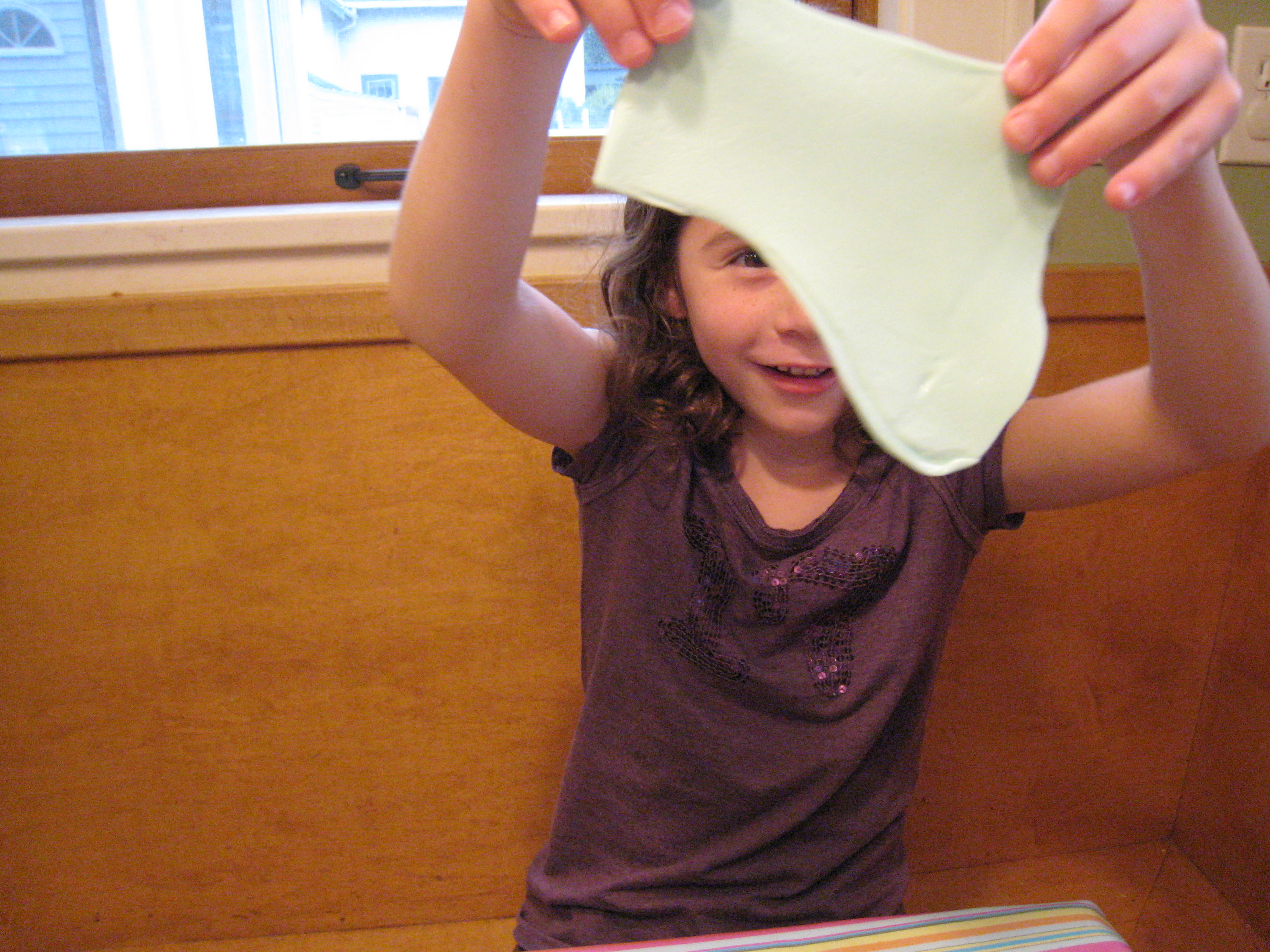
What could be more fun than creating your own green slime to play with? It’s easy to synthesize your own green goo using only Elmer’s glue (the non-washable kind), Borax (found in the laundry detergent section of most stores), green food coloring and water.
In a bowl, have your child mix together about 1/3 cup glue and 1/3 cup water with a spoon or Popsicle stick. These measurements don’t have to be exact. Add a few drops of green food coloring and mix well.
To make the Borax solution, add around a cup of water to a jar. To the water, add about a Tablespoon of Borax. Have your child shake the jar to dissolve as much of the Borax as possible. You are making what is called a saturated solution, so it may not all dissolve! Don’t worry, it will work just fine.

Have your child add about a teaspoon at a time of the Borax solution to the glue/water mix. After each addition, have them stir the mixture together. You should see long strings begin to form and stick together. Keep adding Borax until the mixture doesn’t feel gluey any more. It will form sort of a shiny playdough-like substance. If you add too much Borax solution, it will feel wet. You should be able to just knead it a little to absorb the extra water! The slime is not toxic, but Borax is soap, so don’t let your kids eat it!
I am a biologist and not a chemist, but here is the science, as I understand it.
Mixing Elmer’s glue with water forms a substance called a polymer, which is a long chain of molecules. (A molecule is the smallest amount of a specific chemical substance that can exist alone, like H2O, a single water molecule). The polymer formed by water and glue is called polyvinyl acetate.
The Borax solution (sodium tetraborate) is a cross-linking substance that makes the polymer chains stick together. As more and more chains stick together, they can’t move around and the goo gets thicker and thicker. Eventually, all the chains are bound together and no more Borax solution can be incorporated.

You can store the slime in plastic bags. If you want to make a larger batch, just remember to mix equal amounts of glue and water and add as much Borax solution as needed.
To make your child feel like a “real” scientist, find an old, button up shirt for your child to use as his or her “lab coat”. It’s fun and will protect their clothes. You could even try to find some old safety goggles in your garage for your child to wear, although the ingredients for this project are relatively safe. (Very young children should always be supervised while doing science projects.)
Have fun!
Zooming Fish
- by KitchenPantryScientist

Here’s a fun, easy science project that I discovered a few years ago on pbskids.org/dragonflytv. My children will do it again and again. Even my three year-old joined in, cutting up construction paper into “fish food” and throwing it into the water.
You will need some sort of pan for water (a cake pan will work), construction paper, scissors, and dish soap. Have your child cut out some fish shapes from the paper (around two inches long works well.) See the photo below. Then, have them cut a small slit in the back of the tail. Put a few inches of water in the pan and add the fish. Before the paper soaks up too much water, have your child add a drop of dish soap behind the fish. The fish should zoom across the water. You will have to add fresh water tothe pan if you want to repeat the experiment.

The soap breaks the surface tension of the water. Tell your child to imagine that the surface of the water is a sheet of fabric and the soap is a pair of scissors. The soap cuts through the water, pushing the fish ahead of it. For a more scientific explanation, have your child look up surface tension or visit the dragonfly tv website!
Don’t forget those science notebooks! Have your children write the date, “surface tension” and record their results. They can try using different liquids (like lemon juice) to see if they will break the surface tension. My kids made some fish out of that foam that is used for craft projects so that they wouldn’t soak up the water! Hopefully, the zooming fish will keep your child interested and busy for a while! Click here to see a video on how to make zooming fish.
Cornstarch Goo-Liquid or Solid?
- by KitchenPantryScientist
This experiment is easy, non-toxic and so much fun that it is worth every bit of the mess it makes. Your kids will love it!

All you need is a cup of cornstarch and half a cup of water with a little food coloring in it (purple and green and red would be gross!) Mix the two ingredients to a medium-size bowl with a spoon or your fingers. The goo should be the consistency of syrup.
Now, play with the mixture! You will discover that it behaves like a solid when you agitate it, or move it quickly, and like a liquid when you let it sit still. Pour some onto plates or into bowls if you want to. We poured it directly onto our table which was pretty messy, but lots of fun! Hold a handful on your palm and watch it drip between your fingers! Roll it into a ball. If it gets too dry, just add a little more water. You can easily clean the goo off of flat surfaces using a plastic spatula. Wash it off hands with water.
Cornstarch molecules are like long ropes. When you leave them alone, or move them slowly, they can slide past each other and look like a liquid. However, if you squeeze them, stir them or roll them around in your hands, the ropey molecules look and feel more like a solid. Materials like cornstarch goo are known as non-Newtonian fluids, since they don’t have the normal properties of either a liquid or a solid.
Click here to watch my video on how to make cornstarch goo.