Tag: nasa’
NASA Soda-Straw Rockets
- by KitchenPantryScientist
This fun activity will teach you a little bit about rockets. It is from one of NASA‘s educational websites and the great rocket template you’ll find below is provided by the Jet Propulsion Laboratory at the California Institute of Technology.
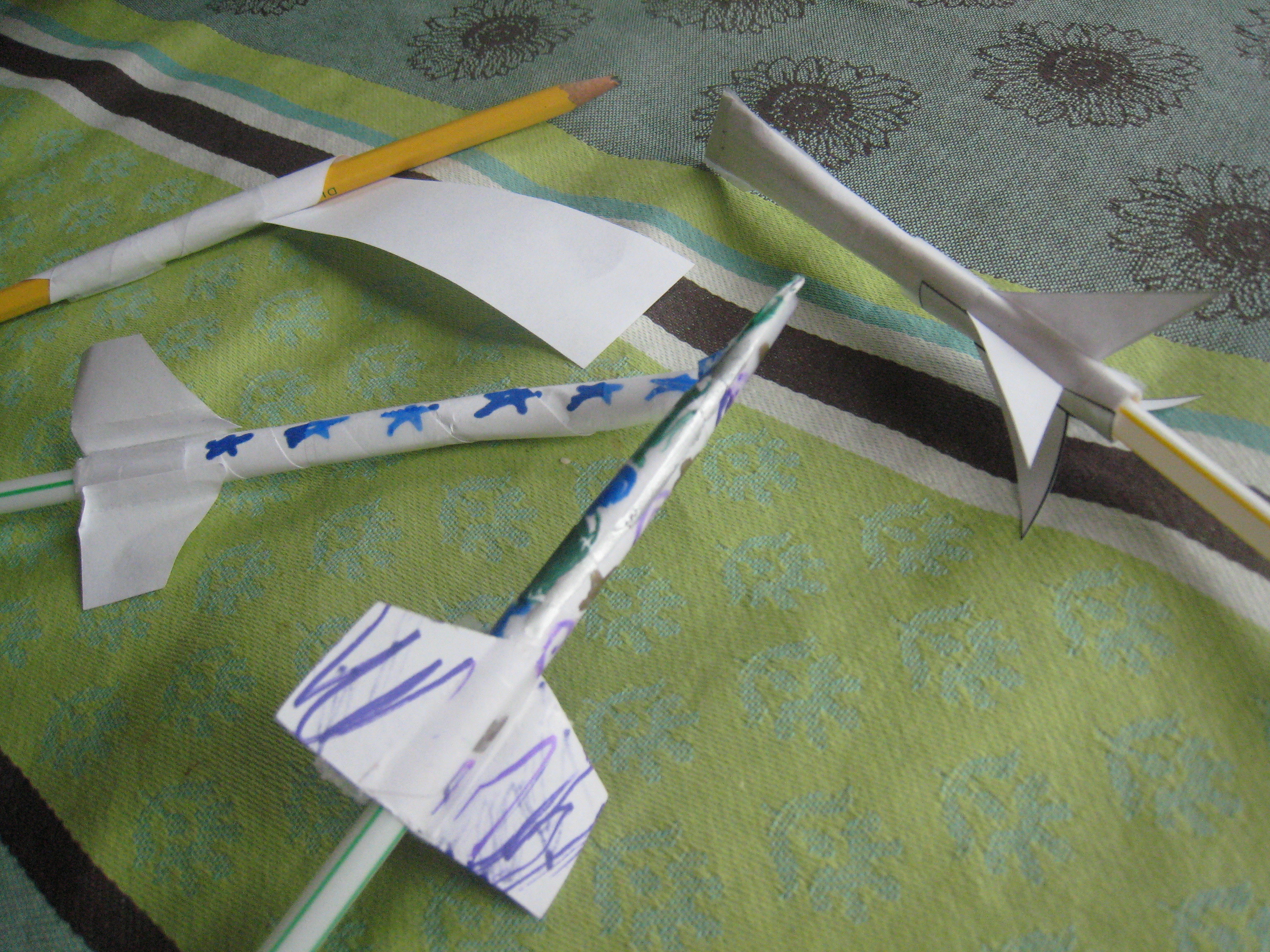
All you’ll need is a plastic soda straw, some paper, scissors and tape. For the body of your rocket, you can use this template or simply cut a strip of paper an inch or two wide. If using the template, wrap the rectangle of paper around a pencil and tape it into a tube. If you’re using a strip of paper, wind it around a pencil (as pictured above) so it forms a tube. Tape it well, so it holds its shape.
Now, remove your rocket from the pencil, fold one end over and tape it down. This will be the nose of your rocket. To the other end, you can make fins using the template, or design your own fins to tape on. Fins work best at right angles, or near right angles. Now you can decorate your creation.
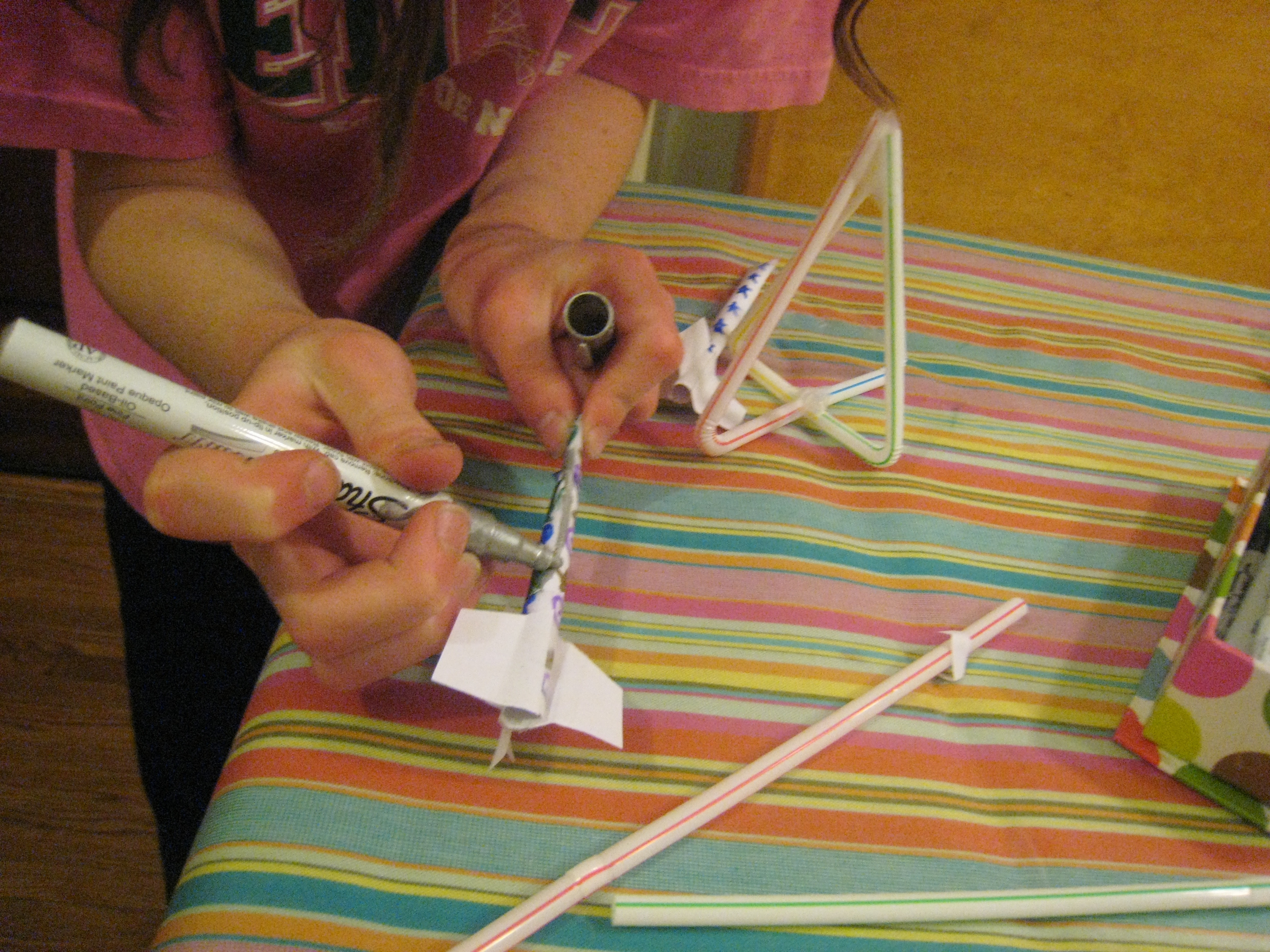
Put your rocket over the end of a straw and use the force of your breath to launch it! How far does it go? Try making longer and shorter rockets. What happens if you change the shape or number of fins? Record your flight lengths.
What does this teach you? Paper rockets demonstrate how real rockets fly through the atmosphere and some of the forces working on them!
Drag is the force of air getting in the way of your rocket. Weight also drags your rocket down as gravity pulls on it. The lighter you make your rocket (less paper, less tape), and the less drag it has, the farther it will go!
Fins stabilize the rockets’ flight. The size and design of the fins affect how well it can be controlled.
We launched some straw rockets at the Kare11 studio, if you want to see them in action!
#SpaceMicrobes
- by KitchenPantryScientist
A soil bacterium we swabbed last spring on the set of Twin Cities’ Kare11 News is headed to the International Space Station! Even though we collected it here in Minnesota, Streptomyces kanamyceticus (we’ll call it S.kan for short) was first isolated from dirt in Japan.
It’s a very cool bacterium. Not only does it grow in really interesting colonies like the ones you see in the photo below, but it produces an antibiotic called Kanamycin that’s widely use in research, industry and medicine. Our #MinnesotaMicrobe takes off on March 16th from Kennedy Space Center on a SpaceX-3 rocket! Follow the mission on Project MERCURRI’s website, here on my blog, or using the #spacemicrobes hashtag on Twitter.

After we sent our sample off in the mail, it was swabbed onto bacterial growth medium and these cool little colonies were grown by the scientists from Project MERCURRI, alongside other samples swabbed from NFL and NBA stadiums, NASA spacecraft, and even from a candy jar at Kare11’s sister NBC studio at the Today Show. Around 40 of the samples were chosen to travel to the International Space Station (ISS) for a “Superbowl” of microbes. Scientists want to study how the bacteria grow and change in space and want to get the public excited about the project.
Why should we care how bacteria grow on the ISS, or on any spacecraft?
Microbes behave oddly out in space, and when humans exit Earth’s atmosphere, we carry microscopic inhabitants along with us. Tiny terrestrials (mostly bacteria) outnumber our bodies’ own cells by about ten to one, and microbes too small to see with the naked eye cover everything you around you, assuming you don’t live in a sterile bubble.
Pseudomonas aeruginosa, a funny little bacterium that smells like grapes and loves water, grows differently in microgravity. These bacteria form slime layers called biofilms and can cause problems for extraterrestrial toilets and water systems, like the ones on the International Space Station (ISS). Here on Earth, P. aeruginosa can make people who have been badly burned and people with cystic fibrosis (CF) really sick.
NASA also discovered that spending time on the International Space Station made Salmonella bacteria, which cause food poisoning, more virulent. In other words, they can make you sicker.
By studying what happens to terrestrial bacteria in space, scientists can discover new ways to fight infectious disease on Earth and hope to prevent mechanical and medical disasters on future space missions. Microbes may even offer ways to clean up waste in space or generate new medications mid-mission. After all, it will take a long time to get to Mars, and it may be a one-way trip for the first humans to travel there!
If you want to make your own microbial growth plates at home to see what’s growing around your house, you can find directions and a video on how to do it here. In the next week or so, I’ll post instructions for a cool new microbiology experiment that I’ve been thinking about.
NASA Earth Science Week
- by KitchenPantryScientist
 As you may know, I’m a huge NASA fan and am constantly amazed at the great educational opportunities they have available for everyone. Next week is Earth Science Week, and you can celebrate by hanging out with NASA scientists online. They’ll host a full slate of social media activities – Twitter Chats, Google Hangout, Reddit, blogs – where students and teachers can connect with some amazing folks. If you can’t participate in the live event, teachers and students can email questions in advance, and come back to the NASA Earth Science Week after the live event to see if their question made the live event. Details on each event (including how and where to email questions) is here: http://climate.nasa.gov/eswSite/eswEvents/
Below is the official announcement, if you’d like to read more, or share it with friends, teachers and homeschoolers:
Celebrate Earth Science Week: Connect with NASA Earth Explorers!
Event Dates: Oct. 14-20, 2012
Under the theme “Discovering Careers in the Earth Sciences,” this year’s Earth Science Week will focus on this very topic: the story of the Earth Explorers who contribute to our understanding of the planet. As a leader in Earth science research and applications, NASA plays a key role in this annual celebration. The American Geosciences Institute, or AGI, has organized this event since 1998.
During Oct. 14-20, 2012, students of all ages can connect to an incredible group of NASA Earth Explorers — from scientists and engineers, to multimedia producers, educators and writers. Find out about their careers, why and how they study the planet and what their typical day is like. Blog posts, Google+ Hangouts and Twitter chats, as well as a webinar and radio interview in Spanish, are just some of the media activities that will allow explorers to tell their stories. You can directly participate by asking questions during the live events or by sending in questions beforehand.
The current schedule of Earth Science Week events includes:
— Tuesday, Oct. 16, 1-2 p.m. EDT — Twitter Chat with polar scientist Thorsten Markus
— Tuesday, Oct. 16, 1-2 p.m. EDT — Univisión Radio interview with scientists Erika Podest and Miguel Román (in Spanish)
— Wednesday, Oct. 17, 1-2 p.m. EDT — Google+ Hangout with Operation IceBridge scientist Christy Hansen, on location near Antarctica
— Wednesday, Oct. 17, 4-5 p.m. EDT — Webinar with Aquarius engineers (in Spanish)
— Wednesday, Oct. 17, 6-7 p.m. EDT – Reddit interview with oceanographer Josh Willis
— Thursday, Oct. 18, noon-1 p.m. EDT — Twitter chat with atmospheric research scientist Erica Alston
In addition, on Oct. 18, the many contributions of women at NASA to Earth science will be highlighted as part of Female Geoscientist’s Day. Together with the NASA Earth Science Week website, the Women@NASA blog will feature three remarkable Earth Explorers.
Visit the 2012 NASA Earth Science Week website (http://climate.nasa.gov/esw2012) for a collection of articles, event information, blog posts, videos and other educational resources in English and Spanish.
Visit the Women@NASA Blog page: http://blogs.nasa.gov/cm/newui/blog/viewpostlist.jsp?blogname=womenatnasa.
Mars Curiosity Landing Video
- by KitchenPantryScientist
I love that filmmaker Brad Canning thanks NASA, NASA’s Jet Propulsion Laboratory (JPL,) Mars and “Our Curiosity.” It’s a great reminder that without the public funding of science, there would be no man on the moon, no International Space Station, and no video of this amazing feat. Our nation’s boldness to go where no one has gone before is one of the things that makes us great.
NASA’s Curiosity Rover Lands on Mars!
- by KitchenPantryScientist
I stayed up until after midnight watching NASA TV’s coverage of Curiosity’s landing on the red planet. It was absolutely amazing and I hope kids everywhere will be inspired to study about space, planets and science in general. If you haven’t visited NASA.gov, you’re missing out on an amazing array of NASA websites dedicated to space and our very own Earth.

NASA image from Mars landing spot taken by Curiosity rover
Here’s the Mars Science Laboratory website, if you want to follow Curiosity’s mission!
Solar Storms and the Zombie Apocalypse
- by KitchenPantryScientist
My son came home from school the other day joking about a zombie apocalypse. Before that, it was the Mayan apocalypse. And now, he keeps hearing about all these “freaky” solar storms. He laughs, but I’m sure his 11-year-old imagination leaves plenty of room for worry.
I can’t kill the zombies lurking in his subconscience, but I can put his mind (and my own) at ease about the solar storms with this short NASA video that explains that we’re in a totally normal sun cycle and are protected by Earth’s atmosphere
En Route to the Space Station
- by KitchenPantryScientist
My sound experiment post will have to wait, because the video NASA is posting from the space shuttle Endeavour is too cool not to share! The video above is from day 2 of the mission as STS-134’s crew travels to the International Space Station.
The astronauts are hard at work, and one of the first things you’ll see is Astronaut Mark Kelly shaking up some plastic cylinders to start a microbiology experiment!!! At the NASA tweetup, we got to see one of these culture tubes close up!
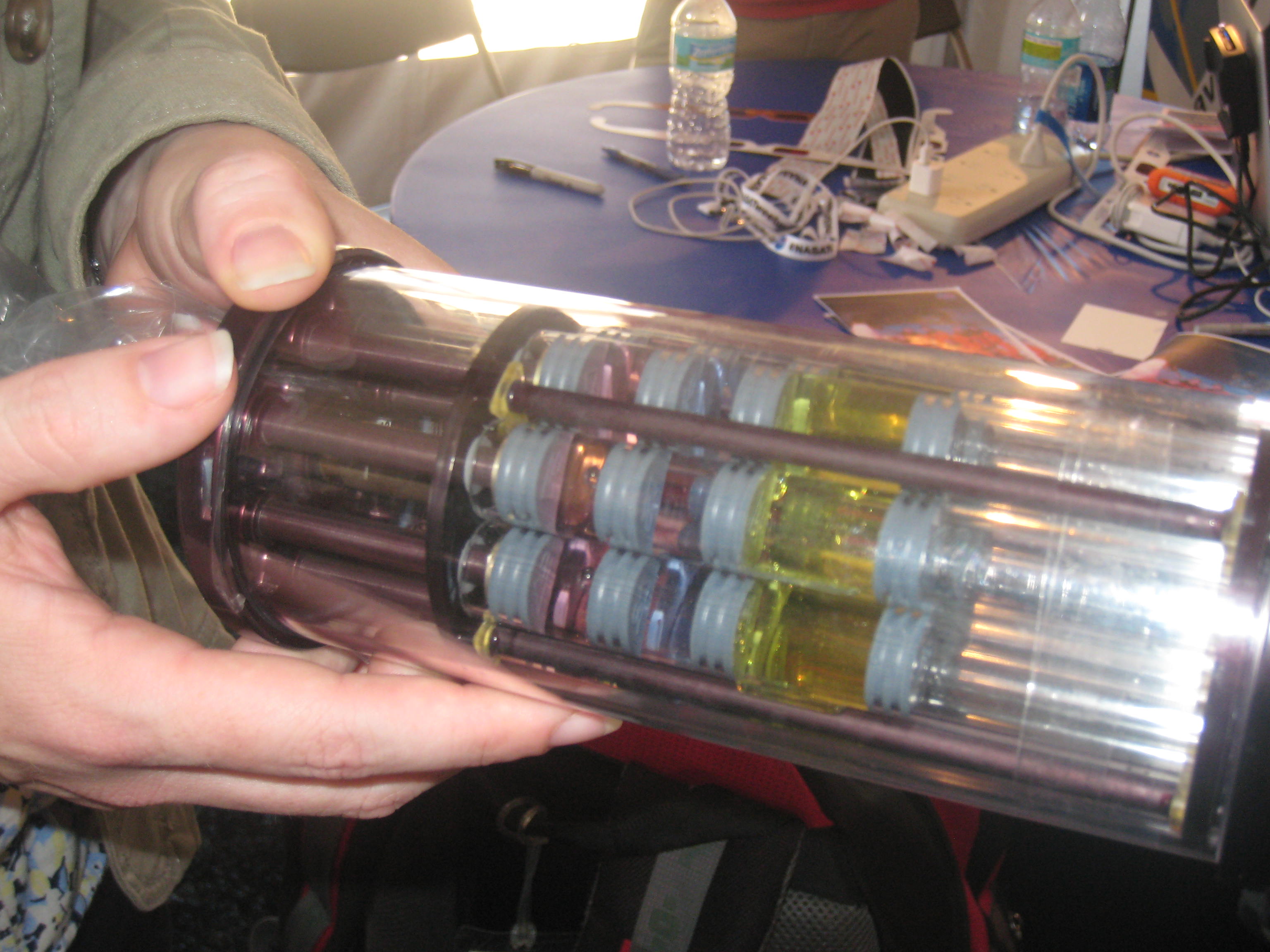
The tube has three compartments: bacteria, liquid food for bacteria, and tiny worms called nematodes that the bacteria can infect! First, they mix the bacteria with the food, then they mix the bacteria with the worms. In space, the bacteria get really “infectious”and “virulent”, and researchers on back earth study them and use the information to make better vaccines to keep people healthy.
Have you ever heard of Salmonella bacteria that can be in eggs and make people sick? This is one of the bacteria they’re studying!
Today, NASA posted this great video of Endeavour “doing a final backflip before docking with the space station.”
Godspeed Endeavour
- by KitchenPantryScientist
Twenty kids stopped eating donuts long enough to shout out a countdown this morning in my living room. We gasped as Endeavour’s rockets blossomed, smiled at the crackle and roar and cheered as she ascended, rolled gracefully and disappeared into the clouds with a flash of orange. We watched in awe as the side booster rockets blew off and the shuttle floated free of the external tank with the curve of the earth in the background. I have to admit that I got a little misty- not because I wasn’t standing at the countdown clock to experience it live, but because despite the laws of physics and all the safety precautions, it still seems like a miracle each time we send people safely into orbit.
Aerogel (Space Jello!)
- by KitchenPantryScientist
When NASA scientists wanted to study star dust (particles from comets and interstellar dust), they had to find a way to slow down the tiny pieces of matter as they flew through space. By the way, interstellar means “between stars.” NASA’s Stardust spacecraft would encounter star dust traveling 6 times the speed of a rifle bullet! At these speeds, a collision with most materials would shatter, or burn up the space dust they were trying to collect.
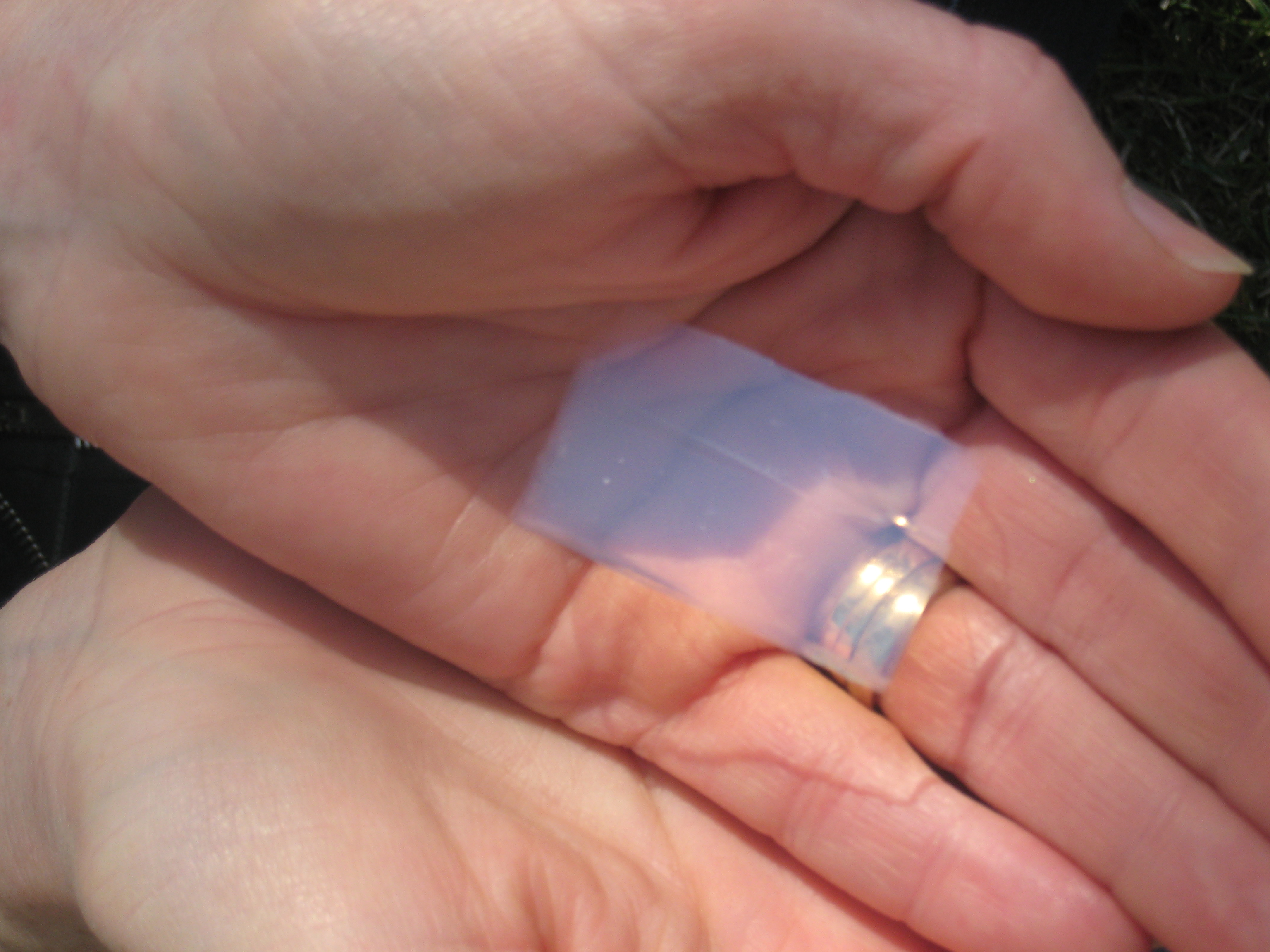
In order to solve this problem, the scientists at NASA’s Jet Propulsion Laboratory (JPL) in California crafted a special “space jello” called Aerogel which could slow space particle down and trap them, undamaged, for study. Aerogel is similar to glass, but is 1000 times less dense. In fact Aerogel is 99.8 percent empty space. Imagine a box of air filled with tiny, tiny glass threads. When space dust hits this jello-like substance, it makes a tiny tunnel in the aerogel that helps scientists find and collect the dust under a powerful microscope. Then they can study the dust to see what it is made of!
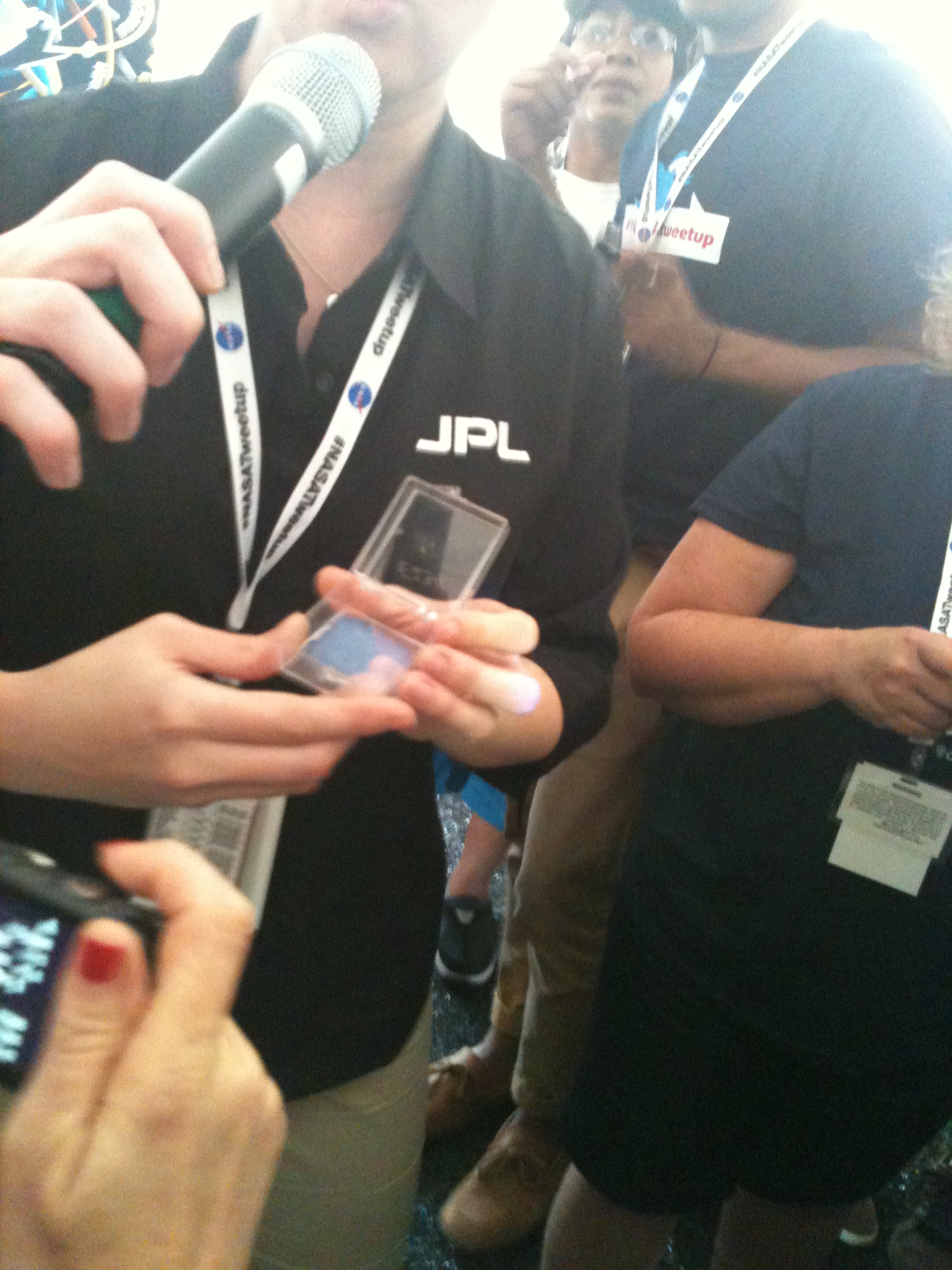
I was luckily enough to get a sample of Aerogel from Stephanie Smith, who works at the Jet Propulsion Laboratory. Aerogel looks like light-blue smoke when you hold it in your hand. It is as light as a feather, but it feels solid, dry, and harder than jello when you touch it! You can read more about Aerogel and the Stardust missions by clicking here, on the JPL website! It’s amazing science. They’ve found many interesting elements and chemical compounds in the star dust already. I can’t wait to see what they find next!
Here’s a video of us playing with the Aerogel Stephanie brought to the NASATweetup! (courtesy of MindspaceLTD)
NASA and the American Dream
- by KitchenPantryScientist
A recent trip to Kennedy Space Center made me feel like a kid again and I’m reveling in a momentary lapse of cynicism. Please excuse me if I sound cheesy, or over the top, but I haven’t come back down to earth quite yet.
The United States is is a young nation. We have not been afraid to explore, and our boldness led us to take humankind’s first steps on the moon.
Naturally, our curiosity has led us to some dead ends and we’ve taken a few tumbles, but through basic scientific exploration and hard work we have stumbled upon a wealth of information that has made each of our lives better.
Even while being robbed of our innocence, our country has managed to hold strong to the ideals of freedom and equality. Sadly, our childlike wonder has not been so lucky and is in danger of becoming a casualty of the aging process. Gravity pulls us down each time we cut funding to scientific research. It doesn’t hurt much yet, but could bring us to our knees.
At Kennedy Space Center the last week of April, I attended a “tweetup” sponsored by NASA for 150 of it’s Twitter followers. There to witness the launch of space shuttle Endeavour, we were given behind-the-scenes tours at NASA and listened to a number of astronauts, scientists, engineers, and technicians speak about working for the space program. Their passion and conviction for what they do was the most patriotic expression I’ve ever witnessed. The message I heard over and over again was the mantra of the American dream.
“Work hard in school and you can be whatever you want to be.” (Maybe even an astronaut.)
“The best stuff is still in front of us.”
“When we stop exploring we will falter.”
NASA is not about astronauts sitting around eating freeze-dried ice cream. It is about exploration and science. It is about “revealing the unknown about the planet on which we live” and learning about our place in the universe. The astronauts on the space station are conducting experiments which will yield better vaccines and cancer treatments, among other things. They’re gleaning priceless information about our home planet that we simply can’t capture with our feet on the ground.
Of course it is important for us to be fiscally responsible as a nation, but we can’t lose our childlike wonder or we will lose what sets us apart from the rest of the world. We will fail to thrive when we fail to explore and make new discoveries. NASA embodies the American spirit of exploration and symbolizes what makes us so great as a nation.
As NASA’s chief scientist Waleed Abdalati said, there is a “brilliant future ahead that is ours for the creating.”